
The Kionslieu Chronicles continue, helping descendants of the Clucas and Kermode families of Kionslieu Farm in Foxdale in the Isle of Man to research their family history. In August 2022 we were delighted to welcome Penny and Jessie to Kionslieu, this is their story.
A visit to Kionslieu Farm in the Isle of Man to research my family history – by Penny
The Clucas family has farmed this land for hundreds of years and so treading in their footsteps was magical for me and my adult daughter, Jessie, as we are direct descendants of the Clucas’s of Kionslieu. My daughter, Jessie wears the 1882 Gaelic gold engagement ring that belonged to her great great grandmother who lived here at the farm as a child. We also treasure a 150 year old sampler completed by little Jane Clucas in 1887 when she was only 12.
I already knew a great deal about our family history. My mother, (Mary, Nee Cowley) helped Terry Kermode compile the Kionslieu chronicles which Fiona has so Kindly made (links below) available on this website for all the Clucas’s and Kermodes who are now scattered around the world.
But I’d forgotten the unique beauty of this magical Island which I’d last visited as a child to stay on a farm near Kionslieu, where my great uncle let me help him milk his cows.
Terry Kermode was my second cousin once removed.
Returning now, I wasn’t ready for the romance, the wildness and emptiness of the landscape, or the hills shrouded in mists and mystery. Thanks to Fiona and Tony for providing a perfect home away from home for our ancestral pilgrimage.
Terry Kermode was my second cousin once removed, his detailed chronicles is brilliantly researched, but very long, links below:
Terry Kermode – An Unfinished Memoir, page 1 – 50
Terry Kermode – An Unfinished Memoir, page 51 – 100
For those looking for a broad brush history of 19th century Kionslieu, here is a shorter alternative:
The Clucas’s of Kionslieu
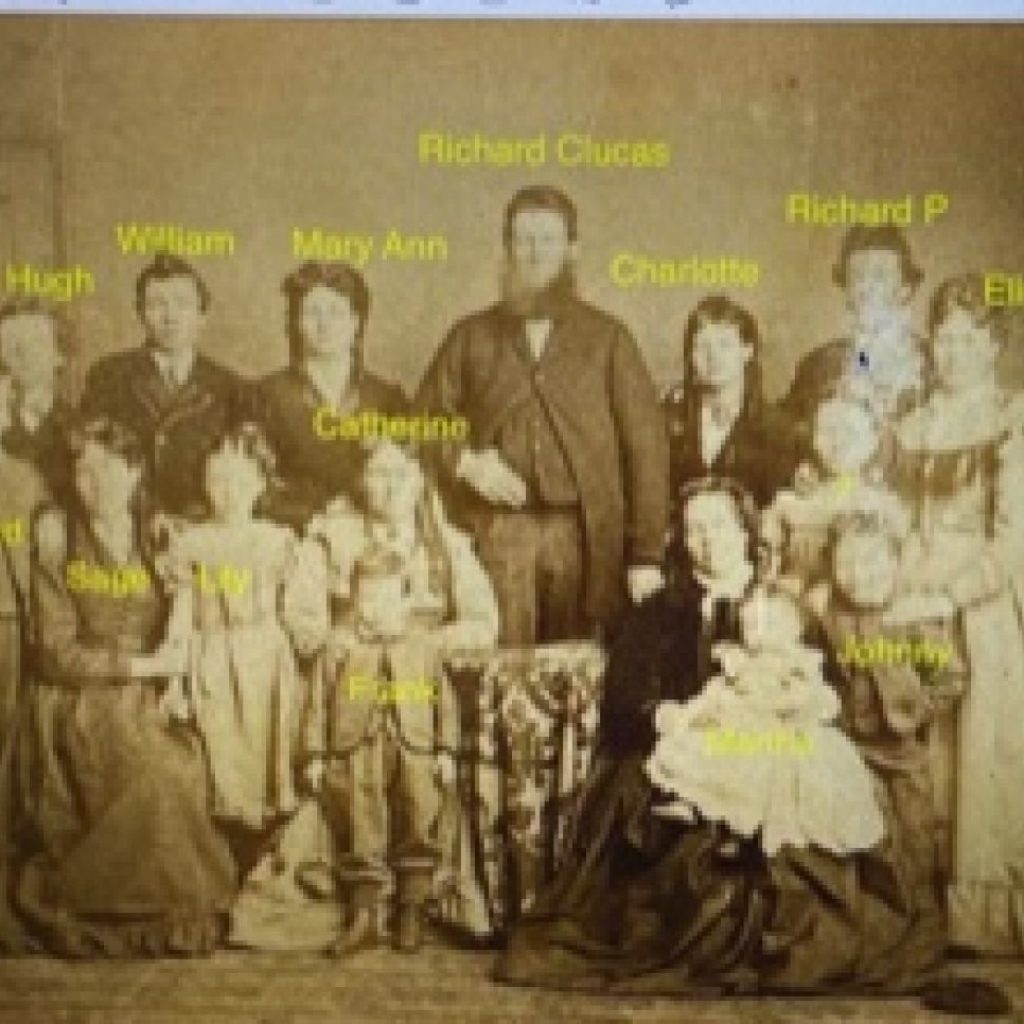
Richard Clucas ( 1816- 73 ) is the earliest Clucas of whom there is a photograph. He is my Great Great Great Grandfather.

Richard Clucas 1816 – 1873 and his wife Christian Corkhill
He was born at Kionslieu, his father John had farmed the land before him, and his father before him … and so on until, we think, before records began. This Richard we know was tall ( 6 foot 4 ) and imposing, and was so “highly thought of that when he died the pall bearers carried his coffin 6 miles to the parish church” in Old Patrick. His wife Christian Corkill was 16 when they married and she had 16 children in 29 years here at Foxdale. Despite that Christian outlived her husband Richard and went on to remarry 2 years after he had died. No doubt she needed support to bring up the rest of her children. She outlived her second husband too. She must have been a strong woman.

The Clucas family
Here is a picture of the Clucas family with the imposingly tall Richard and his ( surely exhausted!) wife Christian centre back row . It was taken in around 1870 in the kitchen of this farm with 15 of their children, Richard died a couple of years after this was taken. One of their children, a son John, died before he reached adulthood and he is missing from the family photo, Jess and I have attempted to identify the children from their ages matching them to the censuses but we could be wrong .
R Clucas and his family – inscription on Kionslieu Farmhouse
This Richard Clucas and his family were fairly well off . The inscription on the side of the house marks their time here.

Although not a “principal” island family, they were significant local land owners of around 70 acres with live-in servants and farm helpers. On the farm back then, the plans show they kept pigs, cows, hens and also horses to pull their ploughs. Eighty percent of the IOM was and remains agricultural land and corn and green crops were grown on farms like Kionslieu as well as potatoes which were introduced to the island in the early 1700’s. They had no running water obviously and life was basic – with only 4 or 5 bedrooms for their children.
After the widowed Christian died in 1897 there was a gap of a few years before her eldest daughter Mary Anne Clucas ( now a Kermode through marriage ) formally took over Kionslieu with her husband John Kermode. We suspect they were already farming the land in the interim when Christian was old and widowed and also for a few years after she died whilst the inheritance of the farm was sorted out. None of the Clucas sons appears to have wanted the responsibility of taking it on.
This is when the farm became the home of the Kermodes.
John Kermode and husband of the eldest Clucas child: Mary Anne started to live and run Kionslieu.
But what happened to Mary Anne’s younger brothers and sisters featured in the sepia photograph? I have found out and can share their stories too as they settled all over the world and between them had 74 children.
Here is a summary; their life choices tell us so much about social history.
The first five Clucas children were all girls: Mary Anne, my Great Grandmother we know about . After her birth in 1842 came her sister, Eleanor Margaret in 1843, then Charlotte in 1884, Catherine in 1846 and Sage in 1848.
The eldest four all remained in the Isle of Man.
Eleanor
Eleanor married a mining engineer in Foxdale and remained here with her 9 children.
Charlotte
Charlotte married another local farmer, William Moore and had 12 children nearby.
Catherine Clucas, daughter of R Clucas married Reverend John Thomas Clarke
Catherine’s story is more curious. Her husband was 40 years her senior, and a venerable Manx figure. He was the esteemed Minister in Foxdale and a widower. She married him when she was only 20 and he was already in his mid sixties,
John Thomas Clarke, (1799- 1888) had been appointed Minister at the local church, St Marks in Foxdale in July 1827 and he stayed there for 37 years becoming known as” the patriarch of St Marks” He writes about his time in the parish and the records are now online and they provide a fascinating history of the parish. Manx Soc vol 28.

Rev Clarke did a great deal to improve living conditions and the church in the village. Two years after he retired from the ministry though he must have surprised everyone when he married Catherine. Rev Clarke is also remembered for publishing (in 1866) an Encyclopaedic English Manx dictionary and a Manx hymnbook.
Together he and Catherine went on to have five children. She moved to Wales after he died remaining there for the rest of her life.
Sage Clucas
The last of Ricard Clucas’s elder sisters was Sage Clucas. Sage married a local farmer, John Curphey, of 50 acres in 1870, but after their first child was born they left together to begin a life in England, setting in Lancashire.
Her great grandson has also visited Kionslieu and has written about her here: https://www.iomfarmholidays.com/the-kionslieu-family/
Sage had three sons and six daughters with John and died in January 1924 in Lancaster, Lancashire, at the age of 80, and was buried in Scotforth, Lancashire. The next 6 children were 5 boys, and one girl, born between 1850 and 1860.
One died young ( John ) and three of the other boys left the IOM; two emigrating as single young men to America;
William and Hugh
William settled In Ohio and then Colorado and had 3 children with his American wife Ida Cassell.
Hugh settled in Colorado and also had 3 children with an American woman: Kate Mordon.
Richard Pinder
The eldest son in the family was Richard Pinder Clucas who also left the Isle of Man in the 1880’s after the farm’s inheritance was settled on his eldest sister Mary-Anne. I think he was unwilling to take it on rather than overlooked. He settled in Cockermouth Cumbria with his wife who was originally from Lancashire. He worked as an “iron worker” there and had 8 children
Edward Walter
The youngest boy of this group, Edward Walter, moved to Lancashire (no doubt to be near his siblings )with his Manx wife Frances Quirk . He worked as a baker there, But he was widowed early and left to care for 6 young children, it looks like he returned to the IOM to work as a confectioner and baker in Douglas.
Christian
Christian, the only girl in this batch moved to Wales and then Tetbury and married a school teacher . She had four children.
The four youngest Clucases born between 1862 -1871 all left the IOM. Their father Richard died in 1872 so life would have been less settled for them as they watched their formidable mother remarry and then move away from Kionslieu. When her second husband died he did not leave his widow Kionslieu, even though it had been her home not his, and the existing legal documents suggest she had her daughter had to fight hard to get it back. No doubt it wasn’t easy for the youngest of her children.
Louisa “Lilly
Louisa “Lilly’ had left the island by 1881 and was working as a servant in Warwickshire, but she was back looking after her widowed mother with her younger sister Martha in 1891.
By 1901 she is married to a Roman Catholic from Lancashire. He was a licensed victualler and together they emigrated to Canada where her husband became a milk man. Together they had 3 children. She died there.
Frank
Frank Clucas followed his elder sister Sage and set off to Lancashire accompanied by his young Manx wife and they had four children together and made a lief there. He was a horse trader and then Hackney cab driver.
Martha
His little sister Martha also followed to Lancashire. She never married but lived with her sister Sage and ran a milliner’s shop, dying in Crewe. She is also mentioned by her great great grandson who visited Kionslieu here
Florence Francis
The very youngest Florence Francis who was born in 1871 also followed her siblings and left Kionslieu. First she went to Tetbury to be near her older sister Christian who was living there and had married a teacher. She then went to Canada to follow her elder sister Lilly. She married there but returned to the UK with her husband and retired in Wales, near her sister Catherine. She was buried in Lancashire near her siblings Frank, Sage and Martha. Although married, she had no children,
The Kermodes of Kionslieu
The Kermodes were an interesting lot too and here is a photo of them taken outside the farm house in 1904.
To be absolutely clear and annoyingly repetitive, the mother in the picture , Mary Anne was a Clucas before she married John Kermode so she is in both photos, above as a Clucas daughter and below as a Kermode mother . Both photos were taken at Kionslieu but about 30 years apart. She and John had 11 children. They were my Great Great Grandparents and in this picture they are seated in the front centre; John with the white beard and Mary Anne to the right.

Marianne Kermode/Cowley
My great grandmother, their daughter, Marianne is seated on the left of her father. She remained on the Isle of Man and married a Cowley, moving to another local farm when she did so.
Four brothers emigrated to America
By 1904 four of her brothers had already emigrated to America and their heads were copy pasted into the photo. They are seated on the far right . (The original hangs in my home.) I’d love to know what took them there, what hopes drove them to a new life. Born in the 1870’s they would have missed the unrest of the potato riots of 1825 but modern communication had transformed life and no doubt one one brother had gone and sent back good reports, the others would have followed.
We also know that the family was musical and that the brothers and cousins formed a barber shop quartet in America, pictured above and known as the Manx Quartet. In the Isle of Man too the family was involved in the musical life of the community.
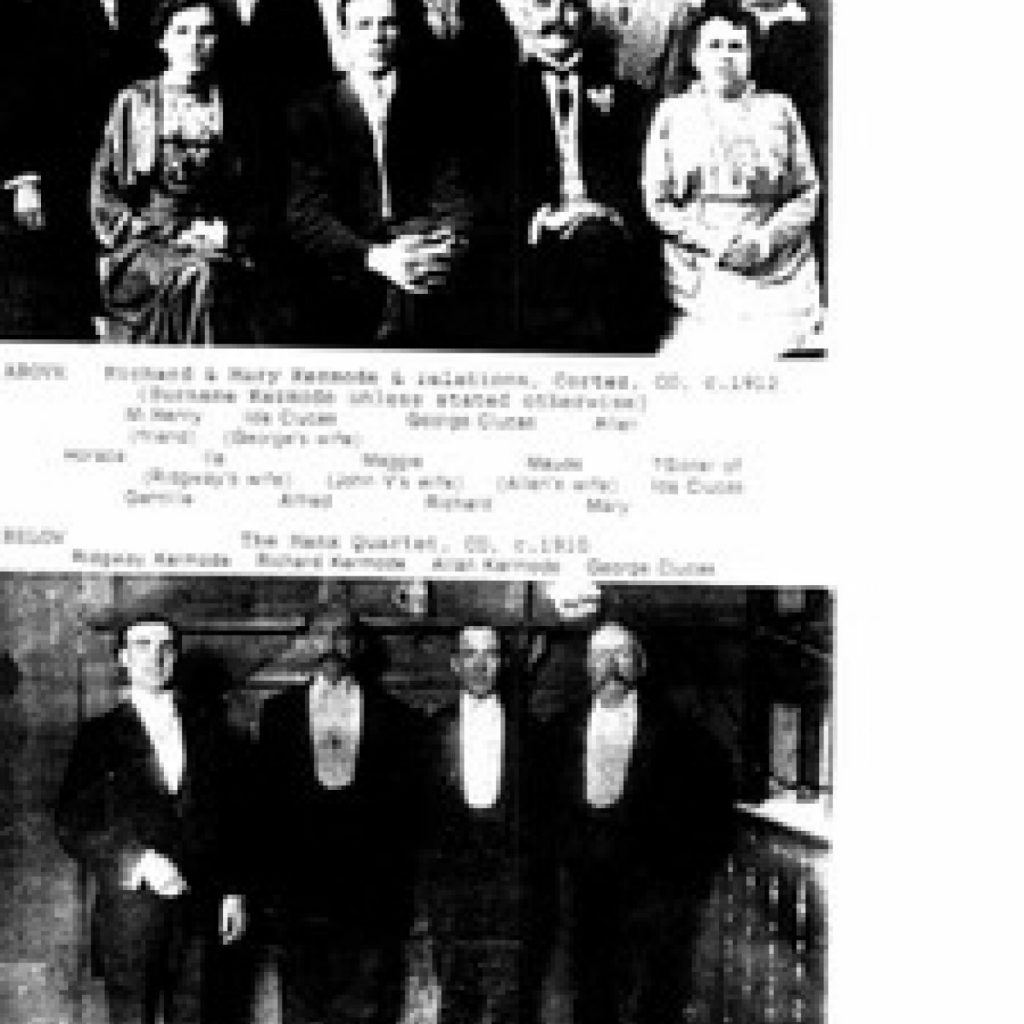
We know that the brothers, once in America , made a success of their lives there and travelled West. Their knowledge of horses helped. Them set up a transport business.
Richard Kermode became the Sheriff of Montezuma County in 1901
Richard in particular ( seated with the curly moustache in the picture) became Sheriff of Montezuma County in 1901: Home Message from Sheriff Spruell Inside MCSO Administration Detention Division Patrol Division Records Division Fees and Costs Civil Division Tenant/Landlord Facts Writ of Restitution Sex Offenders Most Wanted CCW Permits Sheriff’s Posse Around Montezuma County History of MCSO

Although yet a comparatively young man, and for only ten years a resident of Montezuma county, so forcibly has Richard Kermode, of Cortez, impressed his sterling manhood and far-seeing and resourceful business capacity on the people of the county, that he has risen to consequence and power among them, and has also achieved a substantial success in business. He is a native of the Isle of Man, England, and is the son of John and Mary Kermode, also English by nativity. He was reared and educated in his native land, and in 1886, at the age of twenty-four, emigrated to the United States, taking up his residence at once in Colorado. He located in San Juan county and engaged in farming, the pursuit of his ancestors for many generations. In 1893 he moved to Montezuma county, and located land two miles north of Cortez, where he passed three years in successful farming. He also served two years as county road overseer, and gave the people such excellent service in this capacity that in 1901 he was elected sheriff. Removing then to the county seat, he started the livery business which he is now conducting there, and has built it up to large proportions, and managed it with great enterprise and close attention to its every want. He has one of the best equipped barns and most active trades in this line in his portion of the country. In 1902 he also took a contract to carry the mails between Cortez and Dolores, and is prosecuting this enterprise with the same vigor and generally good results that characterize all his other undertakings. In addition to his home place he owns a ranch of one hundred and sixty acres eight miles from Dolores; and on the two he has find herds of well-bred cattle. Fraternally he is a member of the Knights of Pythias and the Woodmen of the World. At Telluride in 1887 he was married to Miss Mary Calhoun, a native of Minnesota. They have two children, Gentle and Alfred. In the discharge of his official duties he is wise, firm and fearless; in his citizenship elevated, patriotic and devoted to the best interests of the county; and in social life genial, companionable an entertaining. He is everywhere popular and highly respected. [Source: Progressive Men of Western Colorado, Publ 1905. Transcribed by Marilyn Clore]
They did not mention that Richard and his brothers owned a silver mine for some years in Silverton, CO.
Whilst staying at Kionslieu Fiona took a picture of us in the same spot as where the 1904 Kermode photo was taken:

Graves at St Paul’s Church, Foxdale, St Runius above Crosby and St Mark’s Church at St Mark’s
John and Marianne Kermode were buried at St Paul’s Church in Foxdale, along with their daughter Julia. (standing behind their parents in the photo) Julia didn’t marry and cared for them in their old age.
One of their sons is marked there : Frank Ridgeway with his first wife, Anne Elizabeth ( Lean) Kermode , who died in 1904 in childbirth in Foxdale . He left for the USA as a young widower and remarried there . He also has a grave with his second American wife in USA (!) so it’s a bit confusing !
There’s several crosses at the very top/north end of the cemetery and that’s essentially Kermode row. Guests might also like to visit the grayeyard in Patrick over near Peel on the A27. There’s the old cemetery north of the church where the earlier Clucases were buried, up to Richard in 1871 I think. They demolished and rebuilt the church mid-19th century on a site further to the south so there’s also a new cemetery down on the south side of the church. I think only Christian (Corkhill) Clucas’ grave is in that section, it’s a tall light brownish-coloured stone memorial near the southeast corner of the church.
Guests might also want to visit Old St Runius Church, which is up on a hill south of Crosby. The earlier Kermodes tended to bury their folk there (not sure if there are any stones left) but they often used St Mark’s Church in Malew parish to baptise their children, St Mark’s is a couple miles south of old Marown church on the A26 as you head down towards Ballasalla.
Seeing that Ridgeway has a grave in St Paul’s in Foxdale, although he died in USA perhaps shows that his heart was always here. I can understand that now having visited myself.
“Through the mists I can see my home”
There is a Gaelic expression used on the island; “Through the mists I can see my home”, and that is how anyone with any Clucas blood running through their veins feels when they find themselves returning to their roots at Kionslieu.
Penny
For links to all of the information gathered about the family history of the Clucas and Kermode families of Kionslieu Farm in the Isle of Man, click the link to Kionslieu Chronicles
The Isle of Man Family History Society website may also be of help – website link
Note from Fiona and Tony – we hope that this information helps with your family history research. If you’d like to visit the island please do get in touch. We have a choice of cottages, a perfect central base from which to explore the beautiful Isle of Man – link below:
To book just email iomcottages@gmail.com or call 01624 801349